From Telegraph to Emergency:
Why Morse Code's SOS Still Matters Today
A 180-year journey from the first copper wire to the pocket in your jeans
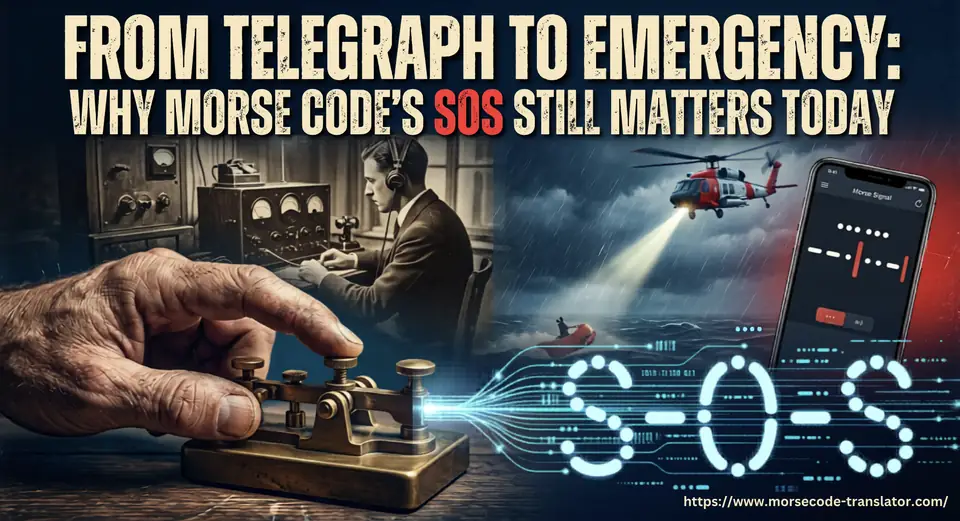
On the freezing night of April 14, 1912, a young radio operator named Jack Phillips sat in the wireless room of the RMS Titanic and did something that would echo through history. As the great ship groaned and tilted beneath him, he tapped out three dots, three dashes, three dots, over and over into the dark Atlantic air. It was a signal the entire world had agreed, just three years earlier, to recognize as a single, universal cry: help us.
That signal was SOS. And the language it spoke was Morse code.
What began in the 1830s as a clever way to send business telegrams down a copper wire had, within a few generations, become the backbone of global emergency communication, a language not of words, but of rhythm and silence that could cross oceans, pierce static, and carry a human plea when no voice could reach far enough.
Today, nearly two centuries after Samuel Morse and Alfred Vail first tapped out their experimental messages, that same code still pulses through our world. Not as a relic. Not as a curiosity. But as a living, functional lifeline that modern people still use to signal distress in the moments that matter most.
This is the story of how that happened.
A language born from silence
The 1830s were a decade obsessed with speed. Newspapers wanted news faster. Merchants wanted market prices before their competitors. Governments wanted to command armies across vast distances without waiting weeks for a horseback messenger. The world was hungry for instant communication, and electricity was about to feed it.
Samuel Morse, an American painter turned inventor, had been captivating himself with the idea of sending messages along an electric wire since 1832. But the genius that made his system actually work came largely from his collaborator, Alfred Vail, a skilled mechanic who reportedly walked into a printing shop, counted how often each letter of the alphabet appeared in a type case, and designed the code so that the most common letters got the shortest signals.
E became a single dot. T became a single dash. The most-used letters were the easiest to send. It was an act of elegant, practical thinking that made Morse code not just functional, but fast.
The telegraph network exploded across continents. By the 1850s, Morse code was the language of commerce, journalism, and government. Operators who could tap and read it fluently were among the most sought-after professionals in the industrialized world. A teenage Andrew Carnegie worked as a telegraph messenger. A young Thomas Edison worked as an operator. The dots and dashes were everywhere.
But no one had yet imagined what would happen when a ship started sinking.
The sea changes everything
The late 19th century brought a new problem: wireless telegraphy. Guglielmo Marconi cracked it in 1895, proving that Morse code could be transmitted without wires, through the air itself, across miles of open ocean. For the first time in history, a ship at sea could speak to the shore.
And almost immediately, ships started using it to call for help.
The early distress calls were a mess. Different navies and shipping companies used different signals. The Germans used "SOE." The British used "CQD", a general call to all stations (CQ) plus D for distress, which operators grimly joked stood for "Come Quick, Danger." There was no agreed universal standard, and in an emergency, confusion costs lives.
"In a crisis at sea, a rescuer who doesn't recognize your distress call might as well be in a different language entirely."
The problem that drove the world to agree on SOSIn 1906, the International Wireless Telegraph Convention met in Berlin and changed everything. They needed a signal that was unmistakable: impossible to confuse with normal traffic, easy to send even by an untrained operator with shaking hands, and recognizable in the thickest static.
They chose three dots, three dashes, three dots: · · · — — — · · ·
Not because the letters S-O-S meant anything in particular (they don't; it's a common myth that SOS stands for "Save Our Souls" or "Save Our Ship"). The signal was chosen purely for its rhythm. In Morse code, it flows as one continuous, symmetrical cascade. Nine signals. No ambiguity. Even a half-trained ear can catch it.
The new standard came into effect on July 1, 1908. And just four years later, it was put to its most famous test.
The night the signal proved itself
When the Titanic struck the iceberg at 11:40 pm on April 14, 1912, operator Jack Phillips initially sent the old CQD distress call. His junior colleague Harold Bride, aware of the new SOS standard, reportedly suggested switching: "It may be your last chance to send it," he said. Phillips started alternating both signals into the night.
The SS Carpathia, 58 miles away, picked up the transmission. It turned and steamed full speed through the ice field. It arrived at 4:10 am and rescued 705 survivors. The 1,517 who perished were beyond its reach, but without that Morse signal punching through the darkness, many more would have been lost.
The world took notice. International adoption of SOS accelerated. Maritime nations drilled their operators. The code, those nine precise taps, was burned into professional memory as the most important sequence a human hand could produce.
First official telegraph message sent by Morse from Washington D.C. to Baltimore. The age of electrical communication begins.
Marconi transmits Morse wirelessly. Ships can now communicate at sea. The language of dots and dashes escapes the wire forever.
SOS becomes the international distress signal. Three dots, three dashes, three dots: one signal, one meaning, every nation on earth.
RMS Titanic sinks. SOS transmissions reach the Carpathia 58 miles away. 705 lives saved. The signal's legend is sealed.
GMDSS replaces Morse as the official maritime distress system. Satellites and digital signals take over. Morse is declared obsolete, officially.
Morse code and SOS persist in survival training, amateur radio, smartphone apps, and real emergencies where every other system has failed.
Declared dead. Still saving lives.
In 1999, the Global Maritime Distress and Safety System officially replaced Morse code for professional maritime use. Satellites, digital signals, and automated beacons made the old system look ancient. Commentators wrote Morse code's obituary. It was a beautiful relic, they said. A museum piece. Something to explain to your grandchildren.
They were wrong.
Morse code, specifically the SOS signal, refused to stay buried, because it has something no digital system can match: it works with almost nothing. You don't need a charged battery, a satellite connection, or a functioning screen. You need a way to make a noise, or flash a light, or tap a surface. Three short, three long, three short. Anyone in earshot who has ever heard of Morse code will understand it.
In a world saturated with technology, that simplicity is not a weakness. It's a superpower.
The iPhone's built-in SOS feature (activated by pressing the side button rapidly) was partly inspired by the universality of the Morse SOS concept: a fast, repeatable physical signal that triggers an emergency response without needing to unlock or navigate a phone.
Modern people, ancient signal
The stories of Morse code's modern survival in real-world situations are not hypothetical. They are real, documented, and humbling.
In 2005, a hiker lost in the mountains of Nevada used a mirror to flash SOS in reflected sunlight (three short flashes, three long, three short) toward a passing aircraft. The pilot recognized it and coordinated a rescue. No phone. No GPS. Just light and rhythm.
In 2014, a fisherman stranded at sea after engine failure tapped SOS on his hull with a metal bar for hours until a nearby vessel finally heard the pattern in the waves of sound. Three short, three long, three short. The rescue crew knew immediately what they were hearing.
Survival manuals distributed by militaries around the world still teach SOS as a core skill. The United States Army Survival Manual (FM 3-05.70) dedicates an entire section to it. The signal can be made with sound (banging, whistles), light (mirrors, torches, phone flashlights), markings in snow or sand (large letters visible from the air), or electronic transmission if any equipment remains.
· · · — — — · · ·
· · · — — — · · ·
And then there is the remarkable fact that SOS has migrated into our smartphones, not as Morse code exactly, but as a direct descendant of the same idea. The iPhone Emergency SOS feature, activated by pressing the side button five times rapidly, was designed around the same principle: a simple, repeatable physical action that anyone can perform under extreme stress, without needing to think or navigate menus.
Samsung's Galaxy phones have a similar feature. Many smartwatches can detect falls and automatically call emergency services. The logic is ancient: when you are in danger and your hands are shaking, you need the simplest possible signal. Three short. Three long. Three short.
Meanwhile, amateur radio operators, hundreds of thousands of them worldwide, still learn and use Morse code today. The American Radio Relay League (ARRL) reports consistent interest in Morse proficiency. In disaster scenarios where cell towers fail and internet infrastructure collapses, ham radio operators using Morse code have repeatedly provided emergency communication when nothing else could get through.
After Hurricane Katrina devastated New Orleans in 2005, amateur radio operators ran emergency communication networks for days. After the 2010 Haiti earthquake, ham operators relayed critical information when all conventional systems failed. Morse code, that 19th-century invention, carried 21st-century emergencies.
Why it endures
There is a pattern to the technologies that refuse to die: they survive not because we are sentimental about them, but because they solve a problem nothing else solves quite as well.
Morse code survives because of three things that no modern technology has managed to replicate in combination.
First, it requires almost no equipment. A rock, a hand, a flashlight: anything capable of producing a signal with two states (on/off, long/short, loud/quiet) becomes a Morse transmitter.
Second, it is human-operable without training in an emergency. Even someone who has never formally learned Morse code can tap three short, three long, three short if they know that sequence means help. The SOS pattern is published in survival guides, stamped on life jackets, and known, at least vaguely, by an enormous slice of the global population.
Third, it degrades gracefully. A weak radio signal carrying voice becomes garbled and unintelligible. A weak signal carrying Morse code can still be read: experienced operators can pull recognizable patterns out of extraordinary noise levels. When communication conditions are at their worst, Morse code is often the last thing still working.
"The beauty of Morse code is that it doesn't care what century it's in. Dots and dashes work the same whether you're tapping a brass telegraph key in 1890 or flashing a phone flashlight in 2024."
The enduring logic of a simple signalThis is why military special forces around the world continue to train in Morse. Why offshore survival courses still teach it. Why it appears in virtually every reputable wilderness survival guide published in the last fifty years. Not out of nostalgia, but because it works when nothing else does.
Samuel Morse tapped his first message in 1844. Jack Phillips tapped his last desperate signal in 1912. A stranded hiker flashed sunlight from a mirror in 2005. A fisherman banged on a hull in 2014.
The signal was always the same: nine taps that carry the weight of a century.
In a world of satellites and smartphones and instant global communication, we have built an extraordinary tower of technology, and at its foundation, almost invisibly, those nine taps remain. A rhythm that means the same thing it always has, in any language, on any ocean, in any emergency: I am here. I need help. Please come.
Morse code didn't become a museum piece. It became infrastructure: quiet, humble, and irreplaceable.
And somewhere out there, right now, it may be the only thing keeping someone alive.
Want to learn Morse code yourself? Practice the SOS signal and more.
Try the Morse Code Translator →Adeel Waqar
Developer, MorseCode-Translator.com · Since 2022
Adeel is a software engineer who founded MorseCode-Translator.com in 2022. Over 3 years later, the platform has grown into one of the most trusted Morse code resources online, serving learners, educators, and enthusiasts across the globe in 10+ languages. The site also offers browser extensions for Chrome, Firefox, and Edge, as well as an Android app on the Google Play Store.